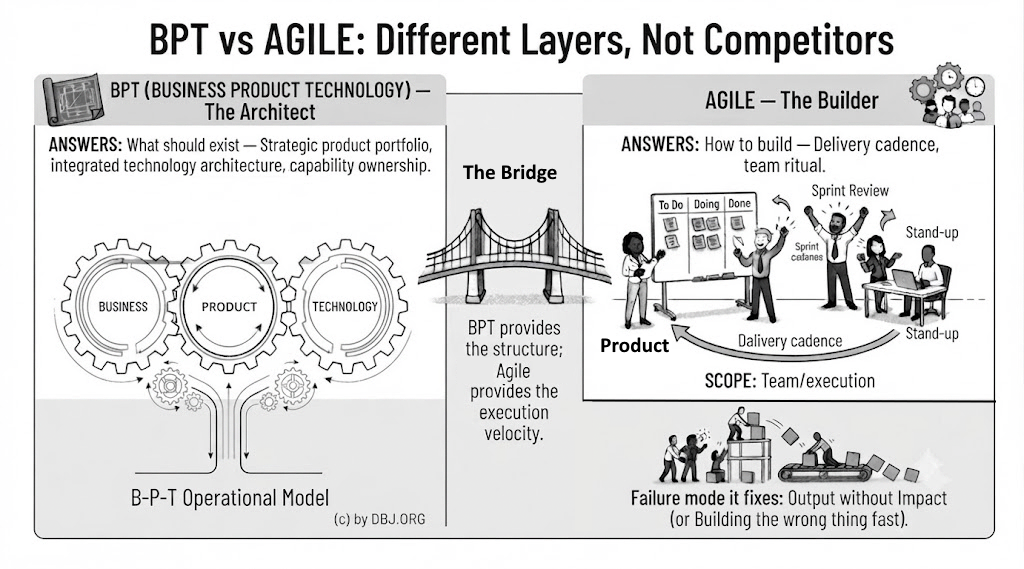
Post-Hype Agents

Post Hype Agents This document defines a pragmatic, engineering-first approach to “Agentic” architectures, aligning them with the rigorous standards of the DBJ Method as established at DBJ.ORG. To move beyond current industry hysteria, we define the “Agent” not as an autonomous entity, but as a Policy-Controlled, Deterministic-Adjacent Task Handler. 1. Core Architectural Principles The Agent is a Consumer: Agents are treated as standard microservices. They pull from event streams (e.g., SQS) and execute strictly defined calls to backend APIs. Semantic Adaptation: The LLM is strictly used as a semantic bridge—translating unstructured input (text, legacy formats) into structured data—not as a substitute for business logic. Determinism First: All logic remains in compiled, testable code. The LLM handles the “intent parsing,” while the DBJ Method dictates the “transactional execution.” 2. Governance and Safety (The “Kill Switch” Model) Following the principles of identity-centric security, an Agent is a first-class identity entity: ...

EA Is an Instrument

Regarding the phrase “EA has to align with AI” — a revolutionary flag being waved high. This time by Gartner: https://lnkd.in/d9F9_QZZ This is completely upside down. EA will not change because of AI; to suggest otherwise misses the point of EA entirely. For 50 years, EA has matured into a vital tool. EA is a precision instrument that tells you, me, and all of us whether a business is truly aligned with its technology. ...

Feature, Not a Bug

© Dusan B. Jovanovic — image generated with Gemini under author’s direction Nobody told you this when you readily signed up for the API key. Every LLM has the same training objective: predict the next token. Not the next true thing. Not the next logical step. The next token — one symbol, conditioned on all the symbols before it. That’s it. That’s the whole game. IMPORTANT It produces text that reads beautifully. It reasons the way a drunk navigates by streetlights — confident, directional, and increasingly wrong. Here is the mechanical problem. Each generated token feeds back into the context as input for the next prediction. So when the model makes a small error at step one, that error is now part of the premises at step two. The mistake doesn’t stay put. It becomes ground truth. The next token is predicted on top of a lie, and the one after that on top of a slightly larger lie, and so on down the chain until you’ve arrived somewhere that sounds perfectly coherent and has nothing to do with reality. ...

Enterprise AI, at Last

Aleph Alpha: The Right Model Aleph Alpha, founded in Heidelberg in 2019 by Jonas Andrulis, built Luminous — a full LLM. Not a wrapper, not a fine-tune of someone else’s weights. Their own architecture, their own training, their own inference. They sit in the same category as OpenAI and Anthropic: model creators, not mills. Their positioning was correct from the start: European sovereign AI. Data stays in Europe. No US cloud dependency. Strong traction with German public sector and defence. The differentiator is not raw benchmark performance — it is explainability and data sovereignty. ...

The Language Layer Does Not Matter

The Language Layer Does Not Matter Andrej Karpathy does not use C. He does not need to. His work sits at the model research and pedagogy layer where Python is the lingua franca. The real compute happens in C and CUDA underneath, but that layer is invisible to him. Training a model takes ten hours in C++ and ten hours in Python — the GPU is the bottleneck, not the host language. ...

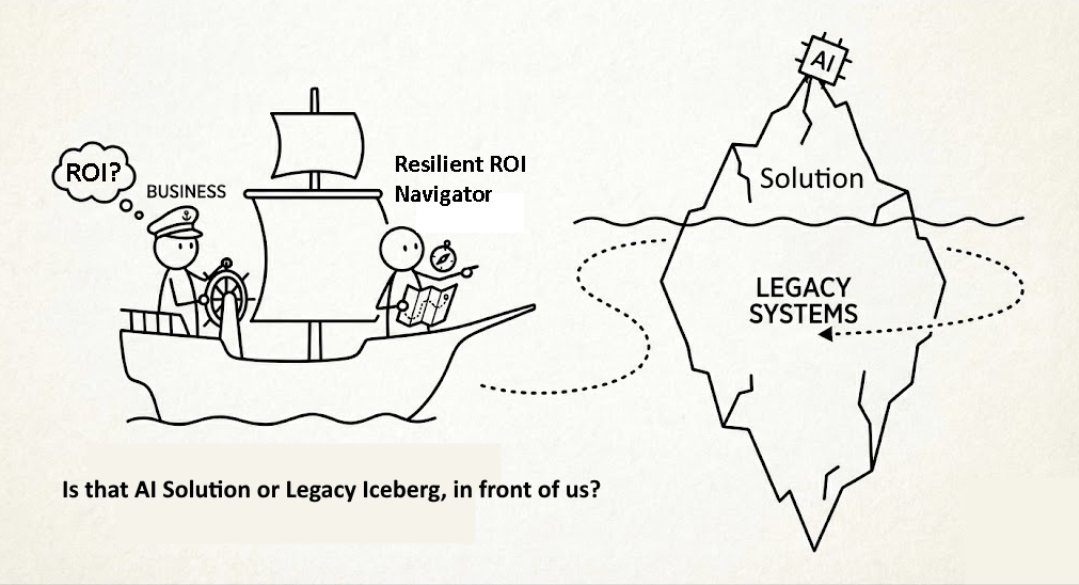
AI or Iceberg: EA as Navigator

Clear roles == Clear communication == Safe Sailing In the words of Susanne Kaiser: “if the underlying system does not evolve…” — here are some risk examples: AI mirrors broken structures: in a big ball of mud with messy models and fuzzy boundaries, it propagates inconsistencies and hallucinates domain meaning AI amplifies organizational frictions: with repeated handoffs between teams, AI-accelerated code generation creates bigger queues at the handoff. It does not increase throughput, but inventory. AI builds the wrong things faster: without strategic guidance, it custom-builds commodities for non-differentiating problems that already have off-the-shelf alternatives. For details: Building Foundations for Continuous (AI-accelerated) Change ...

Modular Monoliths for Mainframe Modernization

Why they fit mainframes: Natural migration path — mainframe applications are already monolithic; modularizing in-place is less disruptive than immediate distribution Transaction boundaries — mainframes excel at ACID transactions within single processes; modular monoliths preserve this strength Reduced network overhead — avoids the latency and complexity of distributed calls that kill mainframe performance economics MIPS efficiency — in-process module calls consume far fewer MIPS than network hops or message queues The Evolution Path Legacy Monolith → Modular Monolith → Selective Distribution Start: Define bounded contexts within existing codebase Refactor: Extract modules with clear interfaces Stabilize: Prove the architecture, reduce technical debt Optionally: Extract specific modules to containers/services only where distribution adds value MIPS Impact Modular monoliths let you optimize hot paths and reduce coupling before adding distributed system overhead — often achieving 30–60% MIPS reduction without leaving the mainframe. ...

Most Valuable Architecture

CMM --> MVA --> AI --> ROI AI won’t fix a broken foundation. Stop pouring budget into AI experiments that stall in the pilot phase. Technical debt is the silent killer of ROI. It’s time to move past the “Minimum Viable” mindset and build your Most Valuable Architecture (MVA). Clean the slate, structure your data, and finally see the returns you were promised. Turn Technical Debt into AI Equity. High complexity shouldn’t be the ceiling for your innovation. The MVA framework provides the structural integrity needed to bypass legacy bottlenecks. By applying a systematic, architectural approach to AI integration, we help you eliminate wasted spend and accelerate time-to-value. ...

Why CMM Onboarding Is DBJ.METHOD's First Step

Question: Why does DBJ begin with Capability Maturity Model assessment rather than jumping straight into technical delivery? Answer: Because transformation fails without measurable organizational readiness. The Foundation Problem Most enterprises attempt AI-assisted modernization while operating at ad-hoc levels. This creates: Misaligned expectations between business and technology Inconsistent terminology across stakeholder groups Undefined accountability for architectural decisions No repeatable process for evaluating technical risk Architecture-led, AI-assisted delivery requires stable foundations. CMM onboarding establishes those foundations before any work begins. ...

Departure from the Cave of Technical Debt

Socrates then supposes that the prisoners are released. A freed prisoner would look around and see the fire. The light would hurt his eyes and make it difficult for him to see the objects casting the shadows. If he were told that what he is seeing is real instead of the other version of reality he sees on the wall of Technical Debt, he would not believe it. In his pain, Socrates continues, the freed prisoner would turn away and run back to what he is accustomed to (that is, the shadows of the carried objects of Technical Debt). The light “… would hurt his eyes, and he would escape by turning away to the things which he was able to look at, and these he would believe to be clearer than what was being shown to him.” ...