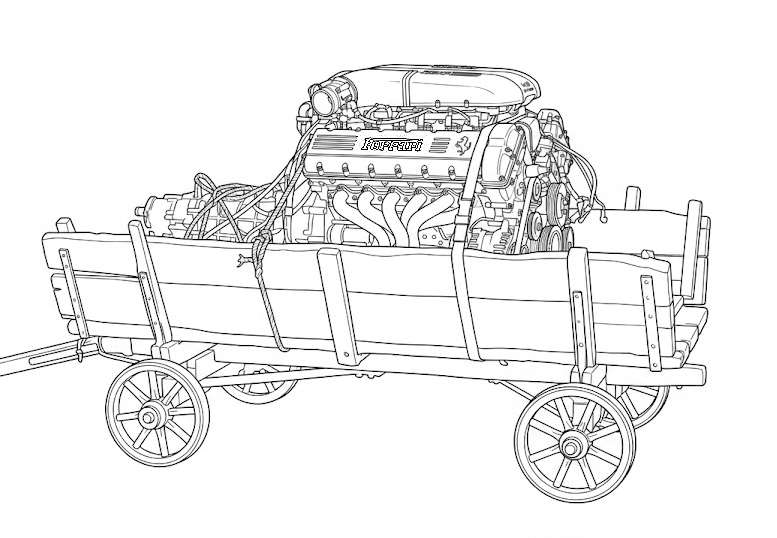
A Ferrari V12 engine dropped into a wooden farm cart.
That is not satire. That is the exact situation most organizations are in right now. The engine is state-of-the-art. The cart is nineteenth century. The wheels are wooden. There is no drivetrain, no chassis rated for the load, and nowhere to sit. The moment you open the throttle, the cart disintegrates.
What “AI Ready” Actually Means
AI-readiness is not a technology procurement question. It is not about which model you license, which cloud you use, or how many GPU hours you can afford. Those are secondary.
AI-readiness is an operating model question.
The DBJ Method is explicit on this: before an organization can extract value from AI, it must be able to absorb AI. That requires processes that are defined, measurable, and owned. It requires decision rights that are clear. It requires data that is governed and trusted. None of that is delivered by the AI vendor. All of it is the product of deliberate operating model work — Business Process Transformation.
BPT Is the Prerequisite
Business Process Transformation is not modernization for its own sake. It is the structural work that makes an organization capable of operating differently. It answers the questions that AI cannot answer for you:
- Which processes are worth automating, and which are broken in ways that automation will only make faster?
- Who owns the output when an AI system produces it?
- What does a correct result look like, and how do you know when you are not getting one?
- Where does human judgment remain non-negotiable?
An organization that cannot answer these questions is not AI-ready. It is AI-exposed — vulnerable to the failure modes that emerge when powerful tools are handed to underpowered processes.
What Happens Without It
The cart in the image does not move. The engine is irrelevant if the structure beneath it cannot bear the load.
In practice this looks like: AI pilots that never reach production because no one owns the process they were meant to improve. Automation that accelerates the production of incorrect outputs. Governance gaps that become liability the moment something goes wrong. Vendors who delivered exactly what was specified and bear no responsibility for the organizational context it landed in.
The technology is not the problem. The technology is ready. The question is whether the organization is ready for the technology.
The DBJ Mandate
For any organization that engages with the DBJ Method, BPT is not optional and it is not sequenced after AI adoption. It is sequenced before. The operating model must be capable of absorbing what AI delivers before AI is introduced.
This is not conservatism. It is the difference between a Ferrari engine in a Ferrari and a Ferrari engine in a farm cart.
Get the operating model right. Then introduce the AI. In that order.
Dušan Jovanović — Enterprise Architect, DBJ.METHOD