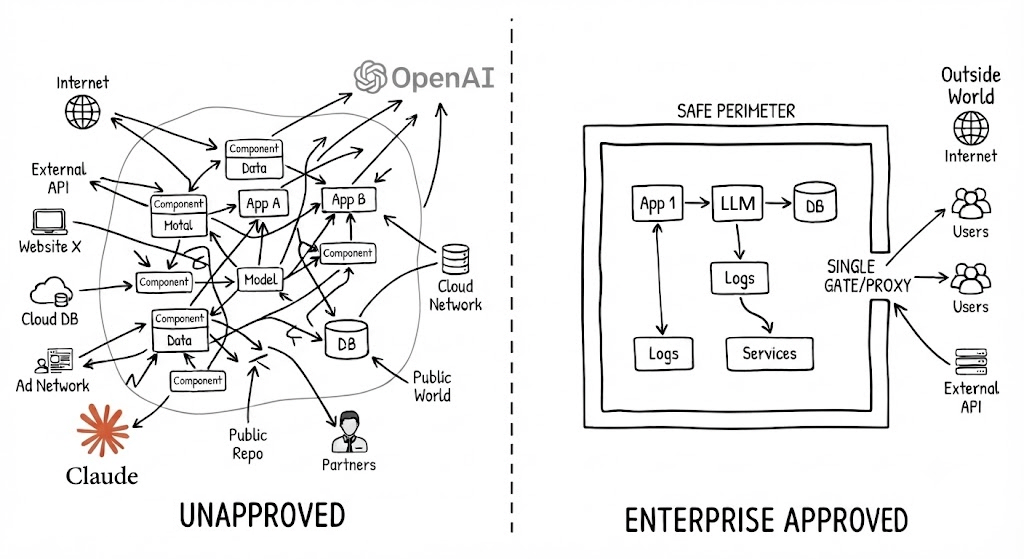
LLM Enterprise Concept
- All is revolving around security
- No organization internal system can “reach out” across the safe boundary
- LLM has to be organization owned and completely hosted inside its safe perimeters
- Safe Perimeter has only one gate
- Single point of entry and exit
- Organization owned LLM
- Same attributes as any other infrastructural part on the “inside” (RDBMS, AD, ESB)
- Same features and capabilities as the “front tier” LLMs
- Also trained on the Enterprise Private Data
Aleph Alpha: The Right Model
Aleph Alpha, founded in Heidelberg in 2019, built Luminous — a full LLMOwn architecture, training, and own inference. Same category as OpenAI and Anthropic: model creators.
Positioning: European sovereign AI. Strong traction with EU public sector and defence.
PhariaAI is the enterprise platform built on top of Luminous.
- PhariaAssistant (chat interface)
- PhariaStudio (development environment)
- PhariaOS (deployment and scaling)
- PhariaCatch (knowledge capture). Full DBMS.
The Key Fact
For on-premises customers, Aleph Alpha grants open access to the full model checkpoint including weights and code.
The Ownership Model
Aleph Alpha’s on-premises model follows the same pattern. Deploy once. Operate independently. Vendor relationship for support and updates only.
This normalises LLM infrastructure the same way RDBMS was normalised in the 1990s. The LLM becomes a licensed infrastructure component, not a cloud service.
EU Bank, EU federal ministry — any of them can run Luminous weights on their own GPU hardware, run the full stack and guarantee that zero data leaves their datacentres inside their safe perimeter.
Identical to an enterprise software licence: support, updates, contractual relationship.
The Cost Consequence
No hyperscaler margin is baked into every token. No egress fees. No per-query cloud billing. The cost model is pure CapEx: buy once, run indefinitely.
The LLM becomes a fixed infrastructure component. Identical to on-premises:
- RDBMS licence
- Messaging middleware (IBM MQ)
- Enterprise Service Bus
For highly regulated industries this is the only viable long-term model. It fully satisfies GDPR . Government guarantees jurisdiction.
The customer owns the hardware. Aleph Alpha provides the software. The correct architecture for the market served.
Conclusion
This is the same pattern that governs enterprise software for thirty years.
Market moves only when the procurement model is familiar. CIOs and CFOs understand CapEx plus support contract. They do not want infinite OpEx tied to someone else’s datacenter at someone else’s margin.
AI that runs on the customer’s own hardware, under the customer’s own governance, with the vendor relationship confined to software and support. LLM on-premises model exists today.
The question for European enterprises is not whether this model is technically viable. The question is how to preserve it.
Dušan Jovanović — Enterprise Architect | CC BY SA 4.0