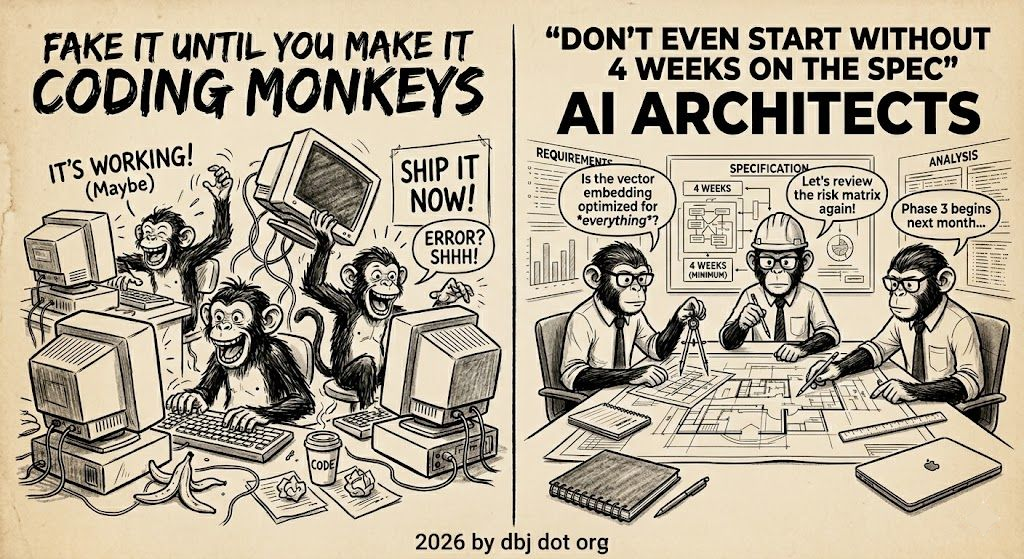
Two teams. Same deadline. Different disasters.
On the left: the coding monkeys. Keyboards rattling, errors scrolling, “It’s working! Maybe—” before the SHIP IT NOW and the inevitable ERROR. Fast. Confident. Wrong.
On the right: the AI architects. Whiteboards full, meetings scheduled, not a single line written yet. “Don’t even start without four weeks on the spec.” Safe. Thorough. Also wrong.
The cartoon is funny because both rooms exist in every organization that has ever touched software.
The fake-it trap
Shipping broken things and calling it velocity is a story as old as Agile cargo-cults. The monkeys aren’t stupid — they’re responding rationally to incentives that reward shipping over correctness. The problem is that “fake it until you make it” only works when the faking has a time limit. When it becomes the permanent operating mode, technical debt isn’t accumulated — it’s the foundation.
AI makes this worse. You can now generate broken code faster than ever. The ERROR comes back in milliseconds instead of hours. That’s not progress. That’s a higher-throughput path to the same collapse.
The over-spec trap
The architects aren’t wrong that spec matters. They’re wrong about the ratio. Four weeks of spec for software that might be invalidated by week two of development is not diligence — it’s delay dressed as rigor.
This trap is particularly seductive with AI in the room. The tools feel so capable that surely, surely, if we just define the problem well enough, the solution will emerge fully formed. It won’t. AI doesn’t rescue bad requirements. It just produces confident-sounding outputs from them.
What’s actually in the middle
Neither team is asking the right question. The right question isn’t “How fast can we ship?” or “How complete is our spec?” It’s: “Do we understand the problem well enough to know when we’ve solved it?”
That’s an architecture question. Not a four-week exercise — a discipline. One that lets you ship early, learn fast, and distinguish a real solution from a working demo.
The monkeys need a bar. The architects need a clock. Both need someone asking whether the thing they’re building is the right thing to build.
The ERROR will come. The question is whether you’ve built something that can survive it.