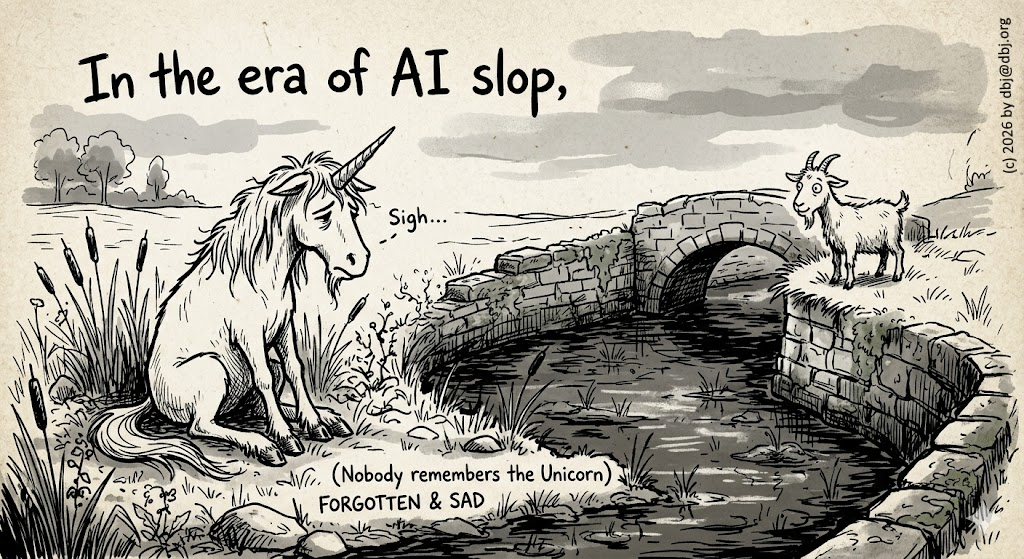
The unicorn is still there. Exactly where it always was.
But. Nobody is looking. Under the avalanche of AI Slop
A goat walked to the side of the moat and it’s fine up there — visible, unremarkable, good enough. The goat didn’t defeat the unicorn. It is just vibed up in greater numbers, at lower cost, faster than anyone could count.
That might be the epitome of the AI slop. Not malicious. Not even bad. Just sufficient — produced at a volume and velocity that makes discernment feel like an unaffordable luxury. (yes I used that word)
Quality didn’t disappear. It became hard to discover.
This is the silent damage. The unicorn problem isn’t erasure — it’s forgetting. Audiences stop developing the taste to recognize quality. Editors stop demanding it because the pipeline never runs dry without it.
Mental buyers stop paying for it because they can’t articulate what they’re missing.
The signal degrades not because the noise is louder but because the noise is everywhere.
Observations
For any organization using AI to generate content, analysis, or advice at scale:
- Volume is not a strategy. A thousand adequate outputs don’t compound into one excellent one.
- Sufficiency is a ceiling, not a floor. “Good enough to publish” is a production standard, not a quality standard.
- Your audience’s tolerance is not your benchmark. Tolerance rises with exposure to slop. It doesn’t mean they prefer it.
The Implications
If your AI strategy is producing outputs nobody remembers, nobody cites, and nobody would miss if they vanished — you have a slop problem, not an AI problem.
The fix isn’t a better model. It’s a higher bar.
The unicorn is still there. The question is whether you’re building an organization that can find it, recognize it, and know what to do with it once it does.
The goat is fine. But you didn’t get into this business to raise goats?