Why they fit mainframes:
- Natural migration path — mainframe applications are already monolithic; modularizing in-place is less disruptive than immediate distribution
- Transaction boundaries — mainframes excel at ACID transactions within single processes; modular monoliths preserve this strength
- Reduced network overhead — avoids the latency and complexity of distributed calls that kill mainframe performance economics
- MIPS efficiency — in-process module calls consume far fewer MIPS than network hops or message queues
The Evolution Path
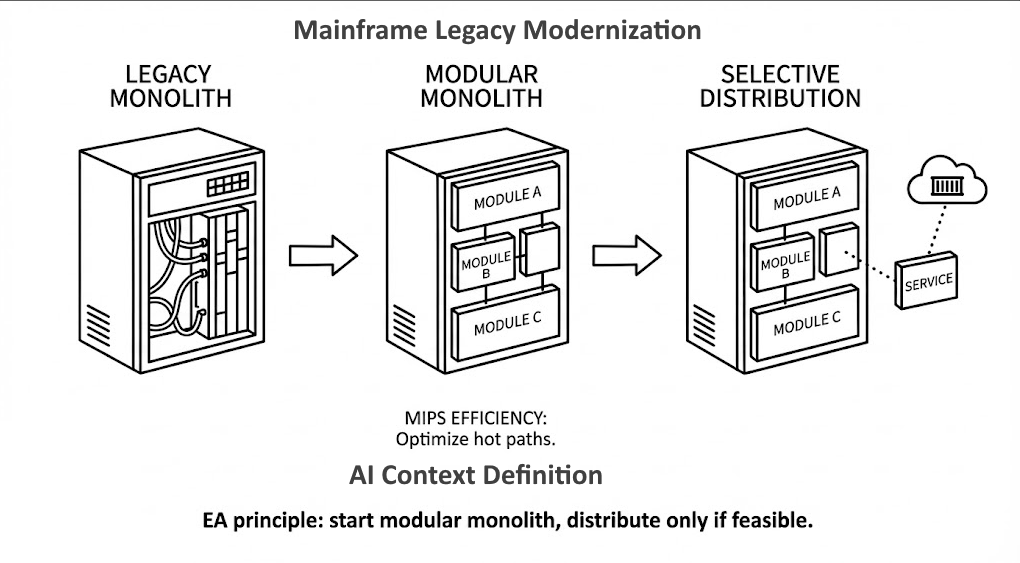
Legacy Monolith → Modular Monolith → Selective Distribution
- Start: Define bounded contexts within existing codebase
- Refactor: Extract modules with clear interfaces
- Stabilize: Prove the architecture, reduce technical debt
- Optionally: Extract specific modules to containers/services only where distribution adds value
MIPS Impact
Modular monoliths let you optimize hot paths and reduce coupling before adding distributed system overhead — often achieving 30–60% MIPS reduction without leaving the mainframe.
MIPS (Million Instructions Per Second) is the billing unit in mainframe environments. Reducing MIPS directly reduces operational costs — often millions annually for large enterprises.
This aligns with DBJ principle: start modular monolith, distribute only if feasible.