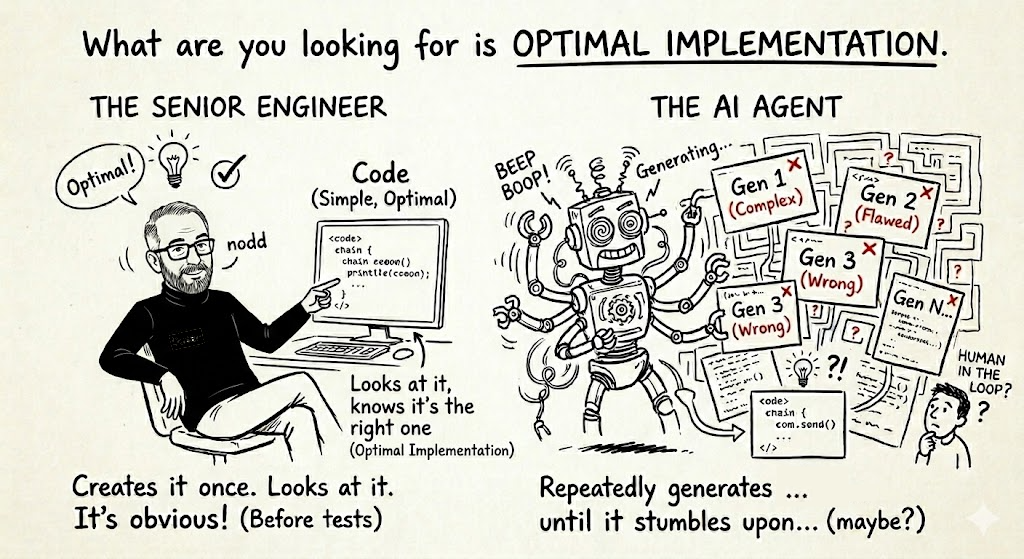
The senior engineer looks at the problem. Builds a mental model. Writes code that is simple and correct. Looks at it again, knows it’s right, moves on.
The AI agent generates. Evaluates. Regenerates. Evaluates again. Tries a variation. Stumbles into something that passes the tests. Maybe.
Same output, different paths. And the path matters — not for sentimental reasons, but for practical ones.
What optimal actually means
Optimal implementation is not the cleverest solution. It’s not the most elegant one. It’s the one that is correctly scoped to the problem, legible to the next person who touches it, and arrived at deliberately rather than by exhaustion of alternatives.
The senior engineer’s advantage isn’t tenure. It’s the ability to collapse the solution space before writing a line. Years of pattern recognition mean most problems arrive pre-sorted: this is a caching problem, this boundary is wrong, this should not exist at all. The code that comes out reflects that compression.
The AI agent has no such compression. It has breadth — vast, statistical breadth — but not the vertical depth that lets a human recognize which part of the problem is load-bearing and which is noise.
Why this matters for enterprise AI adoption
Organizations that replace senior engineering judgment with AI generation pipelines are not getting faster senior engineers. They are getting faster junior ones — with no mechanism for the junior-to-senior transition, because that transition happens through the accumulation of exactly the kind of deliberate, wrong-then-right-then-understood experiences that generation pipelines skip.
The output looks similar. The institutional knowledge does not accumulate.
The right framing
AI generation is a tool for exploring solution space. Senior engineering judgment is a tool for collapsing it. You need both. The mistake is using the first as a substitute for the second.
If your AI strategy produces outputs that nobody on the team could explain, defend, or confidently modify — you don’t have an implementation. You have a draft that passed review because nobody knew what to look for.
Optimal implementation requires someone who knows what optimal looks like.
The AI generates until it stumbles upon something. The senior engineer starts where the stumbling would have ended.