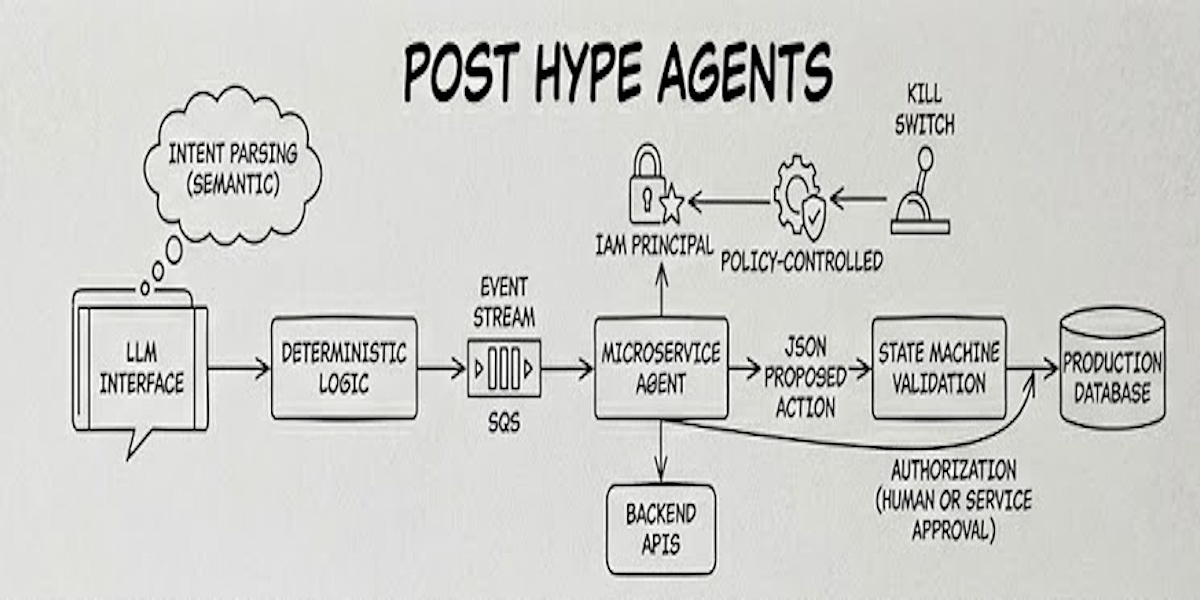
Post Hype Agents
This document defines a pragmatic, engineering-first approach to “Agentic” architectures, aligning them with the rigorous standards of the DBJ Method as established at DBJ.ORG.
To move beyond current industry hysteria, we define the “Agent” not as an autonomous entity, but as a Policy-Controlled, Deterministic-Adjacent Task Handler.
1. Core Architectural Principles
- The Agent is a Consumer: Agents are treated as standard microservices. They pull from event streams (e.g., SQS) and execute strictly defined calls to backend APIs.
- Semantic Adaptation: The LLM is strictly used as a semantic bridge—translating unstructured input (text, legacy formats) into structured data—not as a substitute for business logic.
- Determinism First: All logic remains in compiled, testable code. The LLM handles the “intent parsing,” while the DBJ Method dictates the “transactional execution.”
2. Governance and Safety (The “Kill Switch” Model)
Following the principles of identity-centric security, an Agent is a first-class identity entity:
- Identity Scoping: Every Agent is an IAM Principal with the minimum possible permission set.
- Policy-Controlled: Governance is decoupled from the Agent. Access is managed by an authorization layer (e.g., Okta) that monitors agent behavior.
- Emergency Revocation: The system must support the ability to instantly sever tokens and revoke access to backend resources if the agent deviates from defined policy or behaves anomalously.
3. The “Human-in-the-Loop” Contract
To ensure system integrity, Agents operate under a strict drafting pattern:
- Proposed Actions: An Agent never writes directly to a production database. Its output is a JSON “Proposed Action.”
- Validation Gate: A deterministic state machine validates the proposal against business rules.
- Authorization: No action is persisted or executed without verification by a secondary service or manual human approval, ensuring that “fuzzy” LLM output never breaches the DBJ Method’s integrity.
4. Operational Reality
For DBJ.ORG and its clients, Agents are a tool for reducing integration friction in legacy or human-heavy workflows. They are modular, observable, and replaceable components of a larger, high-reliability architecture. They are not magic; they are just another interface for data ingestion and intent classification.