An open-source event-driven control plane for platform engineering — and what it gets right about operational workflows.
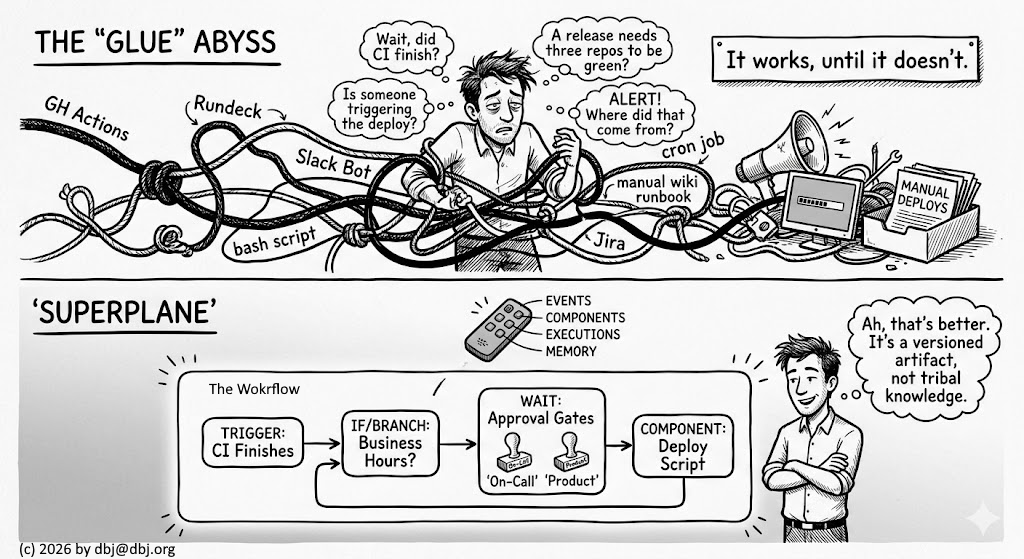
Platform teams write a lot of glue: bash scripts, cron jobs, Slack bots, wiki pages titled “runbook.” That stitches CI, alerts, and release trains together — until it doesn’t, and then the “glue abyss” opens, nobody knows which piece failed.
SuperPlane is an open-source attempt to fix that at the source: a control plane that sits across your existing toolchain — GitHub, PagerDuty, Datadog, Slack, and 40+ others — and coordinates actions between them without replacing any of them.
The model.
A Workflow in Superplane lingo is Canvas: a directed graph of Components, triggered by Events (webhooks, schedules, CI completions, alerts). Executions track state and expose full history in the UI and CLI. A built-in Memory store lets a workflow accumulate context across runs instead of just reacting to isolated events.
The problem it solves. Take a policy-gated deploy: CI passes, only during business hours, on-call and product sign off, then ship. That logic lives in four places and is invisible when it breaks at 2am. On a Canvas, each gate is a node, the trace is inspectable, and the workflow is a versioned artifact — not a tribal knowledge. The same model covers progressive delivery, multi-repo release trains, and incident triage.
The ‘significant others’ GitHub Actions is per-repo with no approval gates. Argo is Kubernetes-native and data-pipeline-focused. Temporal is powerful but developer-facing — you write code, not a workflow graph.
SuperPlane targets the operator who needs to model a process spanning multiple systems without hand-rolling a distributed state machine. Thanks to SuperPlane, the person actually running the process, and just documenting it.
Simplicity. Container-first: Go/TypeScript/Postgres, Apache 2.0. One Docker command to try it locally; single-host or Kubernetes for production.
docker pull ghcr.io/superplanehq/superplane-demo:stable
docker run --rm -p 3000:3000 -v spdata:/app/data -ti ghcr.io/superplanehq/superplane-demo:stable
The AI Agents can drive workflows through the SuperPlane CLI, and Claude and OpenAI are first-class graph nodes — not a side experiment, but a step with inspectable inputs, outputs, and retries.
Honest assessment.
It’s early and moving fast; expect rough edges. But the abstraction level is right: the workflow belongs to the platform team, not the toolchain, and the execution history belongs to your ops record, not a vendor’s SaaS.
SuperPlane is open source, Apache 2.0. Repository: github.com/superplanehq/superplane. Documentation: docs.superplane.com.
Not Marketing
- Agent (built-in, drives workflows, Build/Ask modes): https://docs.superplane.com/concepts/agent/
- Claude component (claude.runAgent, claude.textPrompt, with example JSON output): https://docs.superplane.com/components/claude/
- OpenAI component: https://docs.superplane.com/components/openai/
- CLI overview (for “drive workflows through the CLI”): https://docs.superplane.com/cli/overview/