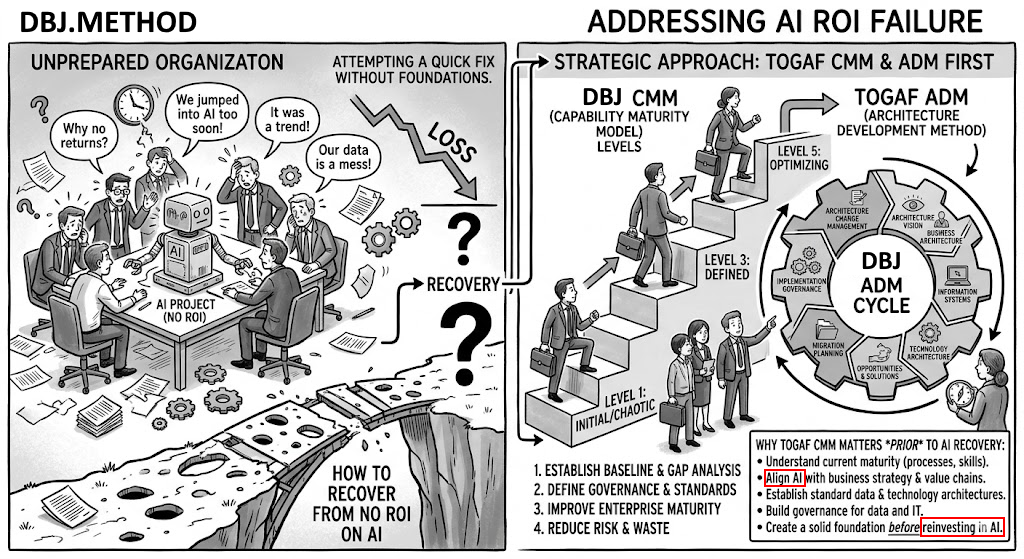
Question: Why does DBJ begin with Capability Maturity Model assessment rather than jumping straight into technical delivery?
Answer: Because transformation fails without measurable organizational readiness.
The Foundation Problem
Most enterprises attempt AI-assisted modernization while operating at ad-hoc levels. This creates:
- Misaligned expectations between business and technology
- Inconsistent terminology across stakeholder groups
- Undefined accountability for architectural decisions
- No repeatable process for evaluating technical risk
Architecture-led, AI-assisted delivery requires stable foundations. CMM onboarding establishes those foundations before any work begins.
The DBJ Method
The DBJ.METHOD method operates as a bridge with two arches: Onboarding and The BPT Loop.
CMM assessment forms the first arch — preparing organizations for sustainable EA-led transformation.
Arch 1: Onboarding
DBJ establishes capability maturity foundations using a two-phase approach.
Phase A: Assessing Current State
DBJ Enterprise Architects evaluate organizational maturity using ACMM Levels L0–L5. This phase evaluates five structural elements present in every organization:
- Governance — decision-making authority, policies, oversight
- Skilled Resource Pool — people and available competencies
- Projects / Portfolios — work initiation, execution, delivery
- Business Operations — day-to-day function and continuity
- Architecture Repository — organizational knowledge base
The organization’s DBJ CMM level is the minimum score across all five elements — a high score in one area cannot mask a critical gap in another.
Assessment activities:
- Establishes shared vocabulary through Common Taxonomy
- Identifies capability gaps via ACMM scorecard across all five elements
- Defines achievable initial target state (L3 — Defined)
Outcome: ACMM baseline assessment with EA-guided improvement roadmap
Phase B: Achieving Defined Maturity (L3)
DBJ Enterprise Architects guide, document and implement architecture processes, transitioning organizations from ad-hoc (L1) to defined (L3) operations.
- Implements governance structures with executive engagement
- Deploys architecture-driven communication practices
- Embeds Common Taxonomy as organizational standard
Outcome: Organization operating at CMM L3 across all five elements — the entry threshold for the DBJ BPT methodology
Why This Matters
Without ACMM foundations:
- Architectural decisions lack organizational support
- Technical debt reduction efforts fail to gain traction
- Business-technology alignment remains superficial
- Transformation initiatives stall in governance gaps
ACMM onboarding ensures organizations can sustain the improvements DBJ delivers.