Post-Hype Agents

Post Hype Agents This document defines a pragmatic, engineering-first approach to “Agentic” architectures, aligning them with the rigorous standards of the DBJ Method as established at DBJ.ORG. To move beyond current industry hysteria, we define the “Agent” not as an autonomous entity, but as a Policy-Controlled, Deterministic-Adjacent Task Handler. 1. Core Architectural Principles The Agent is a Consumer: Agents are treated as standard microservices. They pull from event streams (e.g., SQS) and execute strictly defined calls to backend APIs. Semantic Adaptation: The LLM is strictly used as a semantic bridge—translating unstructured input (text, legacy formats) into structured data—not as a substitute for business logic. Determinism First: All logic remains in compiled, testable code. The LLM handles the “intent parsing,” while the DBJ Method dictates the “transactional execution.” 2. Governance and Safety (The “Kill Switch” Model) Following the principles of identity-centric security, an Agent is a first-class identity entity: ...

EA Is an Instrument

Regarding the phrase “EA has to align with AI” — a revolutionary flag being waved high. This time by Gartner: https://lnkd.in/d9F9_QZZ This is completely upside down. EA will not change because of AI; to suggest otherwise misses the point of EA entirely. For 50 years, EA has matured into a vital tool. EA is a precision instrument that tells you, me, and all of us whether a business is truly aligned with its technology. ...

Feature, Not a Bug

© Dusan B. Jovanovic — image generated with Gemini under author’s direction Nobody told you this when you readily signed up for the API key. Every LLM has the same training objective: predict the next token. Not the next true thing. Not the next logical step. The next token — one symbol, conditioned on all the symbols before it. That’s it. That’s the whole game. IMPORTANT It produces text that reads beautifully. It reasons the way a drunk navigates by streetlights — confident, directional, and increasingly wrong. Here is the mechanical problem. Each generated token feeds back into the context as input for the next prediction. So when the model makes a small error at step one, that error is now part of the premises at step two. The mistake doesn’t stay put. It becomes ground truth. The next token is predicted on top of a lie, and the one after that on top of a slightly larger lie, and so on down the chain until you’ve arrived somewhere that sounds perfectly coherent and has nothing to do with reality. ...

Enterprise AI, at Last

Aleph Alpha: The Right Model Aleph Alpha, founded in Heidelberg in 2019 by Jonas Andrulis, built Luminous — a full LLM. Not a wrapper, not a fine-tune of someone else’s weights. Their own architecture, their own training, their own inference. They sit in the same category as OpenAI and Anthropic: model creators, not mills. Their positioning was correct from the start: European sovereign AI. Data stays in Europe. No US cloud dependency. Strong traction with German public sector and defence. The differentiator is not raw benchmark performance — it is explainability and data sovereignty. ...

The Language Layer Does Not Matter

The Language Layer Does Not Matter Andrej Karpathy does not use C. He does not need to. His work sits at the model research and pedagogy layer where Python is the lingua franca. The real compute happens in C and CUDA underneath, but that layer is invisible to him. Training a model takes ten hours in C++ and ten hours in Python — the GPU is the bottleneck, not the host language. ...

AI or Iceberg: EA as Navigator

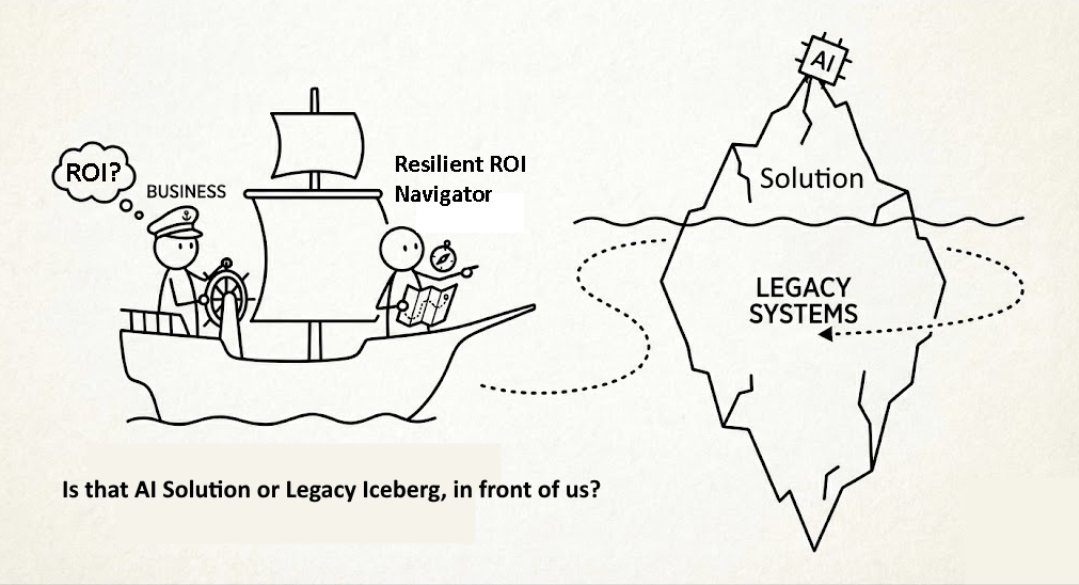
Clear roles == Clear communication == Safe Sailing In the words of Susanne Kaiser: “if the underlying system does not evolve…” — here are some risk examples: AI mirrors broken structures: in a big ball of mud with messy models and fuzzy boundaries, it propagates inconsistencies and hallucinates domain meaning AI amplifies organizational frictions: with repeated handoffs between teams, AI-accelerated code generation creates bigger queues at the handoff. It does not increase throughput, but inventory. AI builds the wrong things faster: without strategic guidance, it custom-builds commodities for non-differentiating problems that already have off-the-shelf alternatives. For details: Building Foundations for Continuous (AI-accelerated) Change ...

Most Valuable Architecture

CMM --> MVA --> AI --> ROI AI won’t fix a broken foundation. Stop pouring budget into AI experiments that stall in the pilot phase. Technical debt is the silent killer of ROI. It’s time to move past the “Minimum Viable” mindset and build your Most Valuable Architecture (MVA). Clean the slate, structure your data, and finally see the returns you were promised. Turn Technical Debt into AI Equity. High complexity shouldn’t be the ceiling for your innovation. The MVA framework provides the structural integrity needed to bypass legacy bottlenecks. By applying a systematic, architectural approach to AI integration, we help you eliminate wasted spend and accelerate time-to-value. ...

The Incompetence Is Out of Hand

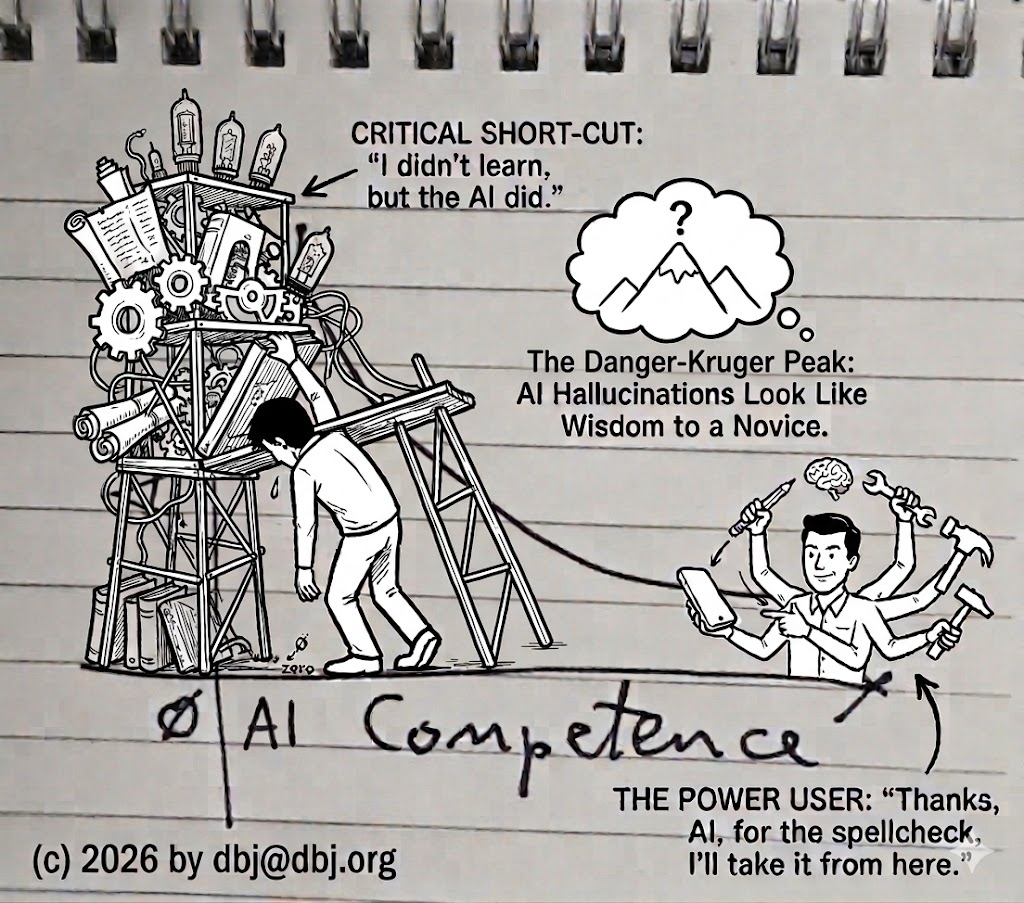
The AI hype cycle is running on fumes — and the fumes are labeled “Future,” “Promise,” and “More AI!” We’ve all seen it. A wobbly tower of buzzwords. Robots with megaphones. Executives cheering at a pile of rubble with “REALITY” written at the base. The cartoon writes itself because the pattern writes itself: Announce the AI initiative Stack acronyms until the tower looks impressive Call any collapse a “learning opportunity” Add more AI What’s actually out of hand isn’t AI. It’s the organizational incompetence that AI is being asked to hide. ...

Crufty AI

There’s a word MIT hackers coined in the 1950s: cruft — useless, tangled, accumulated junk that makes a system incomprehensible and impossible to build on. Sound familiar? In 2026, we have a new variant: crufty AI. Chatbots bolted onto data silos. LLMs fed dirty, unstructured, undocumented inputs. Automation layered on top of processes nobody fully understands anymore. Pilots that never graduate. Dashboards nobody uses. Vendors paid. ROI: zero. This isn’t an AI problem. It’s a cruft problem. ...

AI History: Postcard from 1979

Is this post card from the past or is this a post card from the future? A fascinating and often overlooked chapter in AI history. Kunihiko Fukushima and his Neocognitron, a pioneering artificial “brain” was developed in 1979. That laid the foundation for today’s deep learning. The “Artificial Brain” (Neocognitron): Created by Kunihiko Fukushima in 1979, it was the world’s first multilayer convolutional neural network. This architecture is now the backbone of modern AI vision systems. The Biological Approach: Unlike most Western AI at the time, Fukushima’s goal was to simulate the brain to understand human vision. The 1970s Context: He conducted this research during the so-called “AI winter” at NHK’s Science & Technical Research Laboratories. The WABOT-1 Connection There was an actual robot rather than just a brain model. WABOT-1, the world’s first full-scale humanoid robot, built in 1973 at Waseda University. It had a limb-control system, vision system, and conversation system, and was estimated to have the mental faculty of a one-and-a-half-year-old child. ...

February 5, 2026 · 1 min · Dusan B. Jovanovic