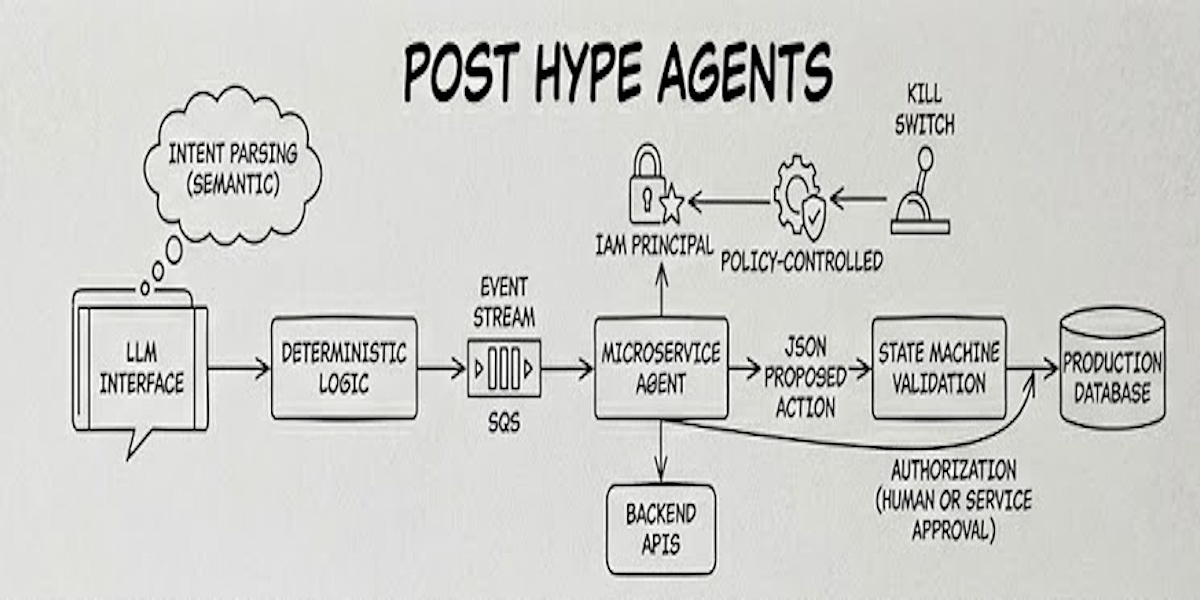
IMPORTANT One Liner Summary: skill.md is not guaranteed to be used DBJ Observations and Comments Observation: runtime infrastructure is not deployment infrastructure Agreed, so what? In the era of the general lack of experienced engineers that has to be said. Plainly. Observation: Skill is key problem is, it is keeping the whole agent scaffolding non-deterministic It’s not Skill, it’s the mechanism that is supposed to use the Skill. Fuzzy natural-language matching against a description, decided by the model at invocation time rather than part of a fixed dispatch. same mechanism is what makes deferred-tool loading (ToolSearch), subagent selection. Also the ordinary tool choice (Grep vs Read vs Agent) is then non-deterministic too. Skills are just the most visible facet of the LLM non-determinism because they’re named and listed explicitly. But skills are used non deterministically. The classical-software analogue is late binding / reflection-based plugin dispatch Skill mechanism is trading a fixed call graph for runtime flexibility, and paying for it in determinism lacking. Repeating. It is not “Skill” that is the problem, it is that harness resolves most capability binding (skills, tools, subagents, memory recall) via probabilistic matching instead of a deterministic dispatch table And that’s a structural feature of the whole LLM architecture, not a flaw isolated to the Skills. There is no deterministic table dispatch. It is as simple as that IMPORTANT The Message
...