Modular Monoliths for Mainframe Modernization

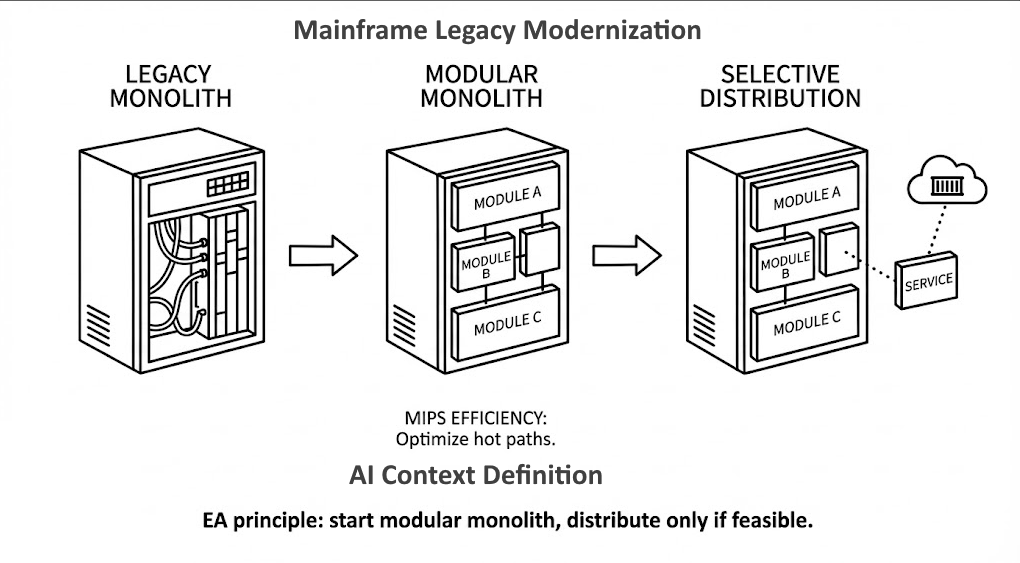
Why they fit mainframes: Natural migration path — mainframe applications are already monolithic; modularizing in-place is less disruptive than immediate distribution Transaction boundaries — mainframes excel at ACID transactions within single processes; modular monoliths preserve this strength Reduced network overhead — avoids the latency and complexity of distributed calls that kill mainframe performance economics MIPS efficiency — in-process module calls consume far fewer MIPS than network hops or message queues The Evolution Path Legacy Monolith → Modular Monolith → Selective Distribution Start: Define bounded contexts within existing codebase Refactor: Extract modules with clear interfaces Stabilize: Prove the architecture, reduce technical debt Optionally: Extract specific modules to containers/services only where distribution adds value MIPS Impact Modular monoliths let you optimize hot paths and reduce coupling before adding distributed system overhead — often achieving 30–60% MIPS reduction without leaving the mainframe. ...

Departure from the Cave of Technical Debt

Socrates then supposes that the prisoners are released. A freed prisoner would look around and see the fire. The light would hurt his eyes and make it difficult for him to see the objects casting the shadows. If he were told that what he is seeing is real instead of the other version of reality he sees on the wall of Technical Debt, he would not believe it. In his pain, Socrates continues, the freed prisoner would turn away and run back to what he is accustomed to (that is, the shadows of the carried objects of Technical Debt). The light “… would hurt his eyes, and he would escape by turning away to the things which he was able to look at, and these he would believe to be clearer than what was being shown to him.” ...