
The .taxonomy File

DBJ Taxonomy defines the language for coordinates of the infospace. Content nobody can locate is content nobody finds. Taxonomy defines the locations on the map the business holds firmly in its hand. Taxonomy is the language used for programming infospace navigation instruments The .taxonomy file connects the abstract taxonomy to actual content. It declares a taxonomy location using the DBJ Core Taxonomy key-words. Any kind of content: repositories of documents, images, specifications. ...
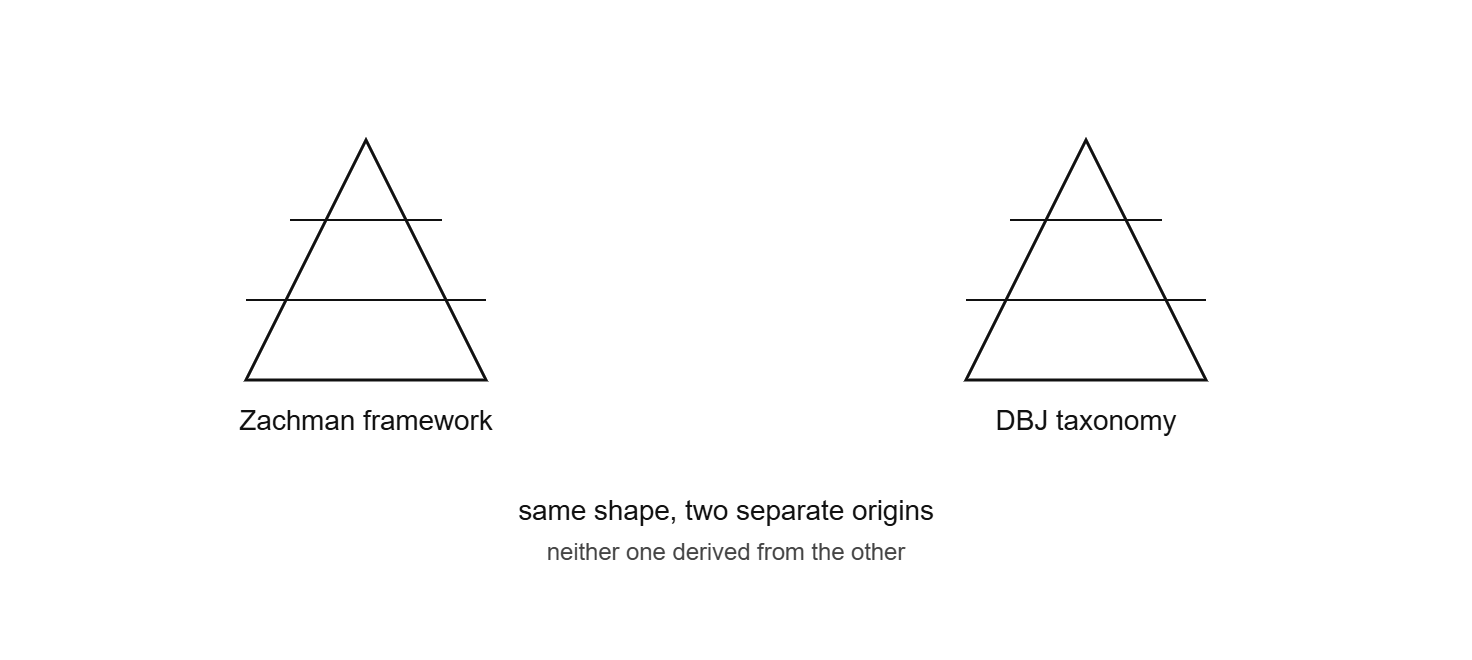
Important: Resemblance Is Not Lineage

Someone described DBJ Taxonomy this way: “a taxonomy that maps to Zachman-style layers (Strategic/Conceptual → Logical → Physical → Implementations).” Sounds credible. Sadly, it isn’t true. That image is the simplified four-layer version quoted in the claim. It’s not what Zachman actually defined — his framework is a 5×6 matrix (Scope/Business/System/Technology/Component crossed with What/How/Where/Who/When/Why), not a single top-to-bottom stack. The linear “Strategic → Logical → Physical → Implementations” progression is a loose paraphrase, which is also why the mapping claim doesn’t hold up. ...

Taxonomy Usage Guide

The classification and an optional declaration The DBJ Taxonomy is a single tree. The top level is an ordered list of categories: Conceptual, Logical, Physical, Implementation. Below it sit the capabilities. Every item has exactly one place in that tree, and the place is its stable ID. Link To the Core That is the whole core. It is deliberately small, and nothing in it is optional. Those names are the keywords. ...